Custom Trading Cards: Sizes, Stocks, Finishes, and Print Costs (2026 Guide)
Custom trading cards are printed on the same 2.5 x 3.5 in trim as a standard poker card, on 310gsm black-core stock, in full-color CMYK on both sides. That single spec covers sports cards, TCGs, artist series, fan sets, and corporate collectibles. What separates a cheap-feeling card from a collectible one is not the size — it is stock, finish, cut tolerance, and packaging. This guide walks the whole spec sheet, with real costs and a file checklist you can hand to a designer today. Price your set whenever you are ready.
What size should custom trading cards be?
Stay on the standard unless you have a reason not to. Sleeves, binders, top-loaders, and grading slabs are all built around 2.5 x 3.5 in.
| Spec | Value |
|---|---|
| Trim size | 2.5 x 3.5 in |
| Document size with bleed | 2.75 x 3.75 in |
| Bleed | 0.125 in all sides |
| Safe zone | 0.125 in inside trim |
| Corner radius | 0.125 in (3.5 mm-class rounded corner) |
| Resolution | 300 DPI minimum |
| Color mode | CMYK |
| Cut tolerance | ±0.02 in |
Oversized sets exist — jumbo trims run larger for display pieces — but they break sleeve compatibility, which collectors notice. The playing card sizes guide compares each trim side by side.
Which card stock works best for trading cards?
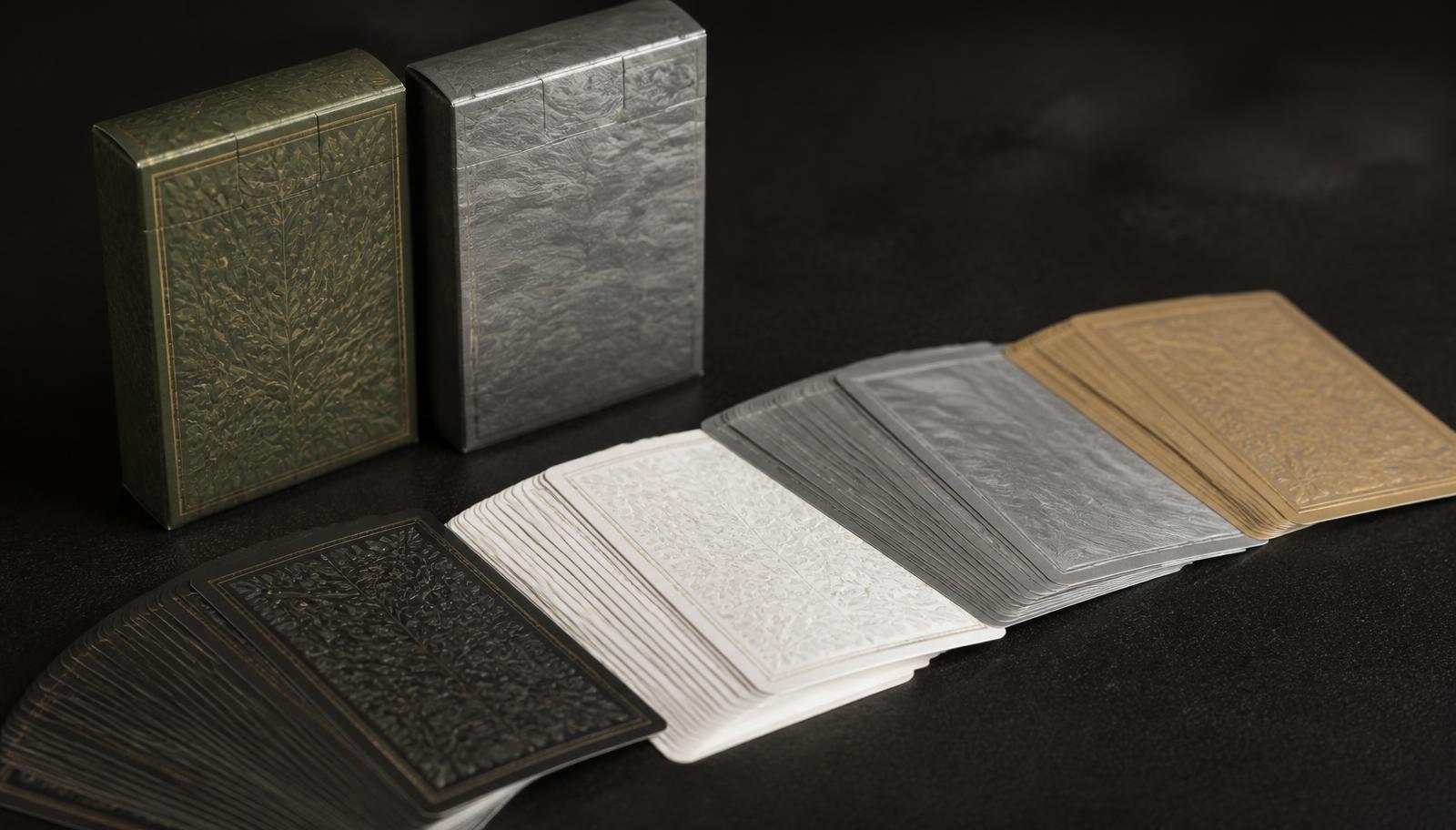
- 310gsm black-core paper. The default. The opaque core stops light bleed, so a bright card back never ghosts through the face. Snappy, colorfast, and the best price-per-quality option at every quantity.
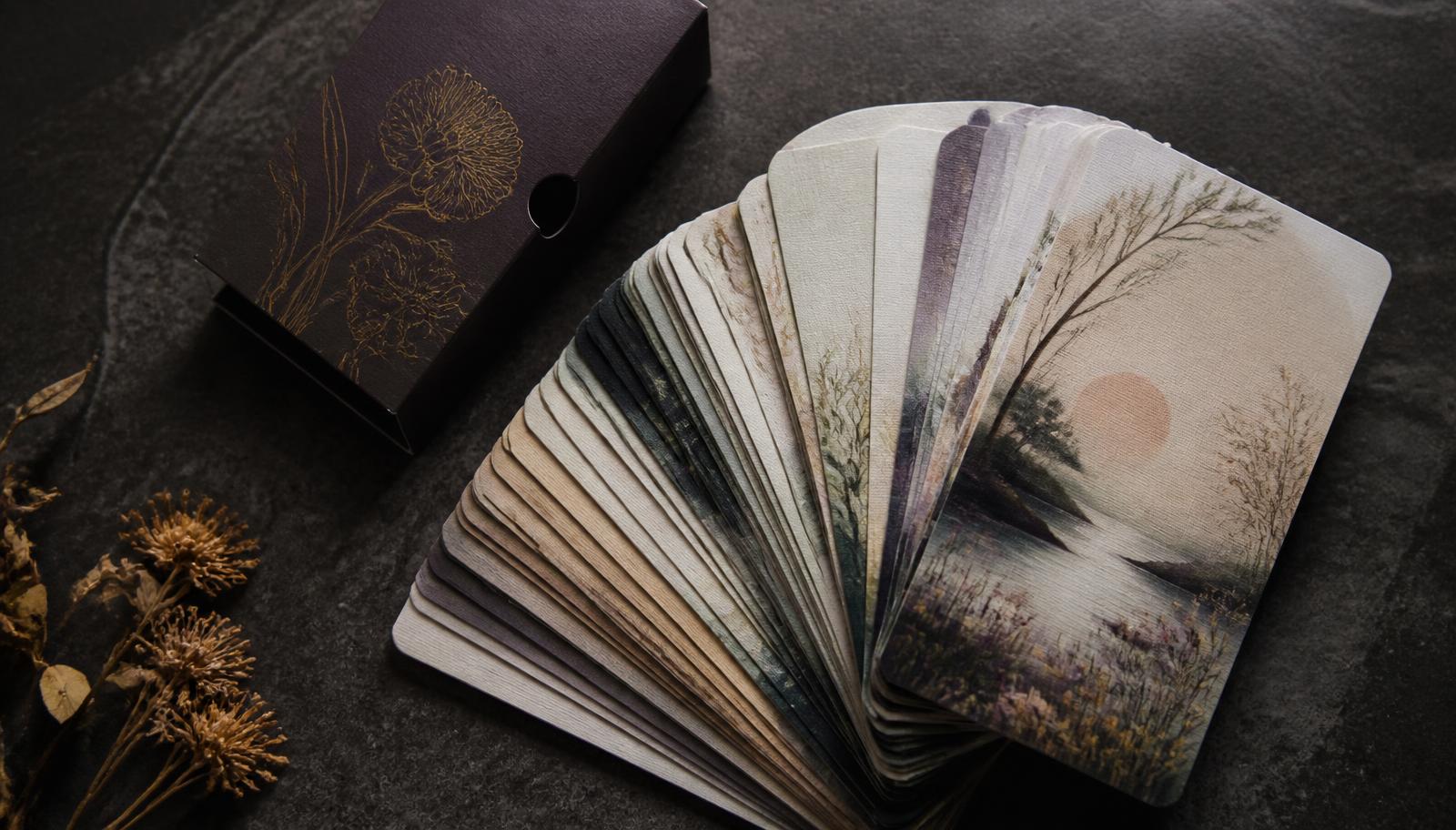
- Premium linen. Air-cushion embossed texture. Choose it when the cards are played, not just collected — the grip and fan quality are noticeably better in hand.
- Deluxe black-core. Heavier, stiffer, maximum opacity. Built for premium retail and limited editions where the card should feel like an object.
- 100% plastic Waterproof and tear-resistant. The right call for outdoor promos, pool and beach giveaways, or anything handled by hundreds of people.
What finishes make a card feel collectible?
Finish is where a set earns a premium price. Each option below is a real press process, not a filter.
| Finish | Effect | Typical schedule impact |
|---|---|---|
| Smooth coating | Clean, vivid, lowest cost | Baseline |
| Matte | Glare-free, photographs well | Baseline |
| Linen air-cushion | Textured grip, premium feel | Baseline |
| Spot UV | Selective high-gloss on logos or art | +3–5 business days |
| Foil stamping | Metallic mirror on names, borders, numbering | +3–5 business days |
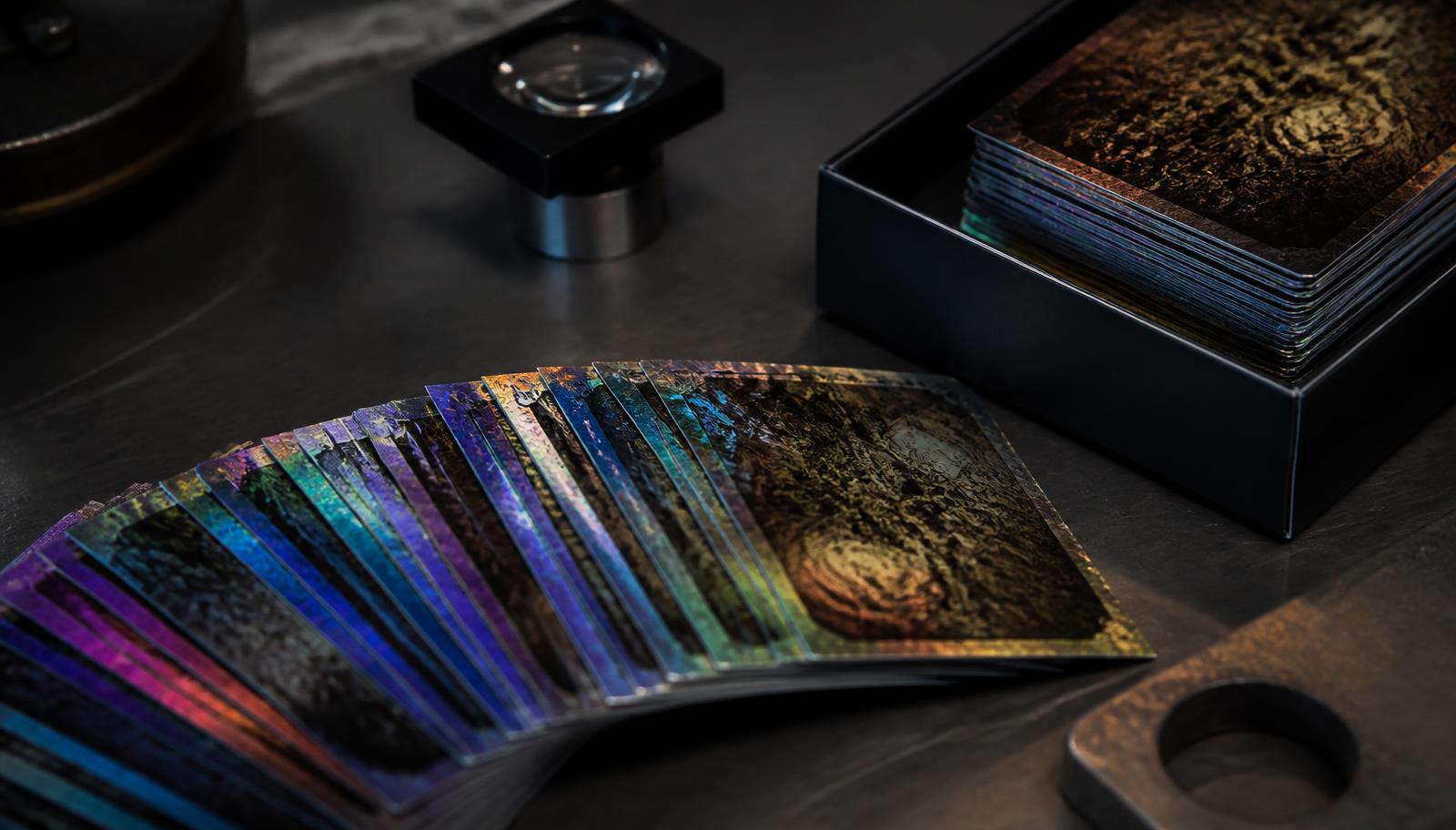
| Holographic board | Full rainbow shift under the ink | +3–5 business days |
| Colored edges | Painted card edges for stacked-deck presentation | +3–5 business days |
Holographic and foil are the two finishes chase-card buyers respond to most. Our holographic card printing guide covers how the effect is built and where it works best.
How much do custom trading cards cost?
Cards are priced by the printed set, so the useful number is per-card cost at your quantity. These figures are for 52-card sets on black-core paper, shrink-wrapped.
| Sets ordered | Per set | Approx. per card |
|---|---|---|
| 15 | $18.99 | $0.37 |
| 50 | $8.99–$10.49 | $0.17–$0.20 |
| 250 | $5.09–$5.59 | $0.10–$0.11 |
| 1,000 | $2.59–$2.99 | $0.05–$0.06 |
| 5,000+ | $1.67–$1.94 | $0.03–$0.04 |
Custom tuck boxes, foil, embossing, metallic ink, and holographic stock are quoted as add-ons on top of these tiers. Full tables live on the pricing page, and the cost breakdown guide explains which options move the number most.
What is the minimum order for a custom card set?
Fifteen sets per unique design. That is deliberately low so a designer can hold a physical prototype before committing to volume — press calibration, color profiling, and die setup cost the same whether the run is 15 sets or 1,500, which is why 15 is the floor. The minimum order guide explains the economics and when to jump to 250+.
How do you prepare trading card files correctly?
Most delays are file problems, not press problems. Work through this list before you upload:
- One file per unique card, named so the sequence is obvious (
card-01-front.pdf). - 300 DPI at final size. Upscaled 72 DPI web art prints soft and there is no press fix for it.
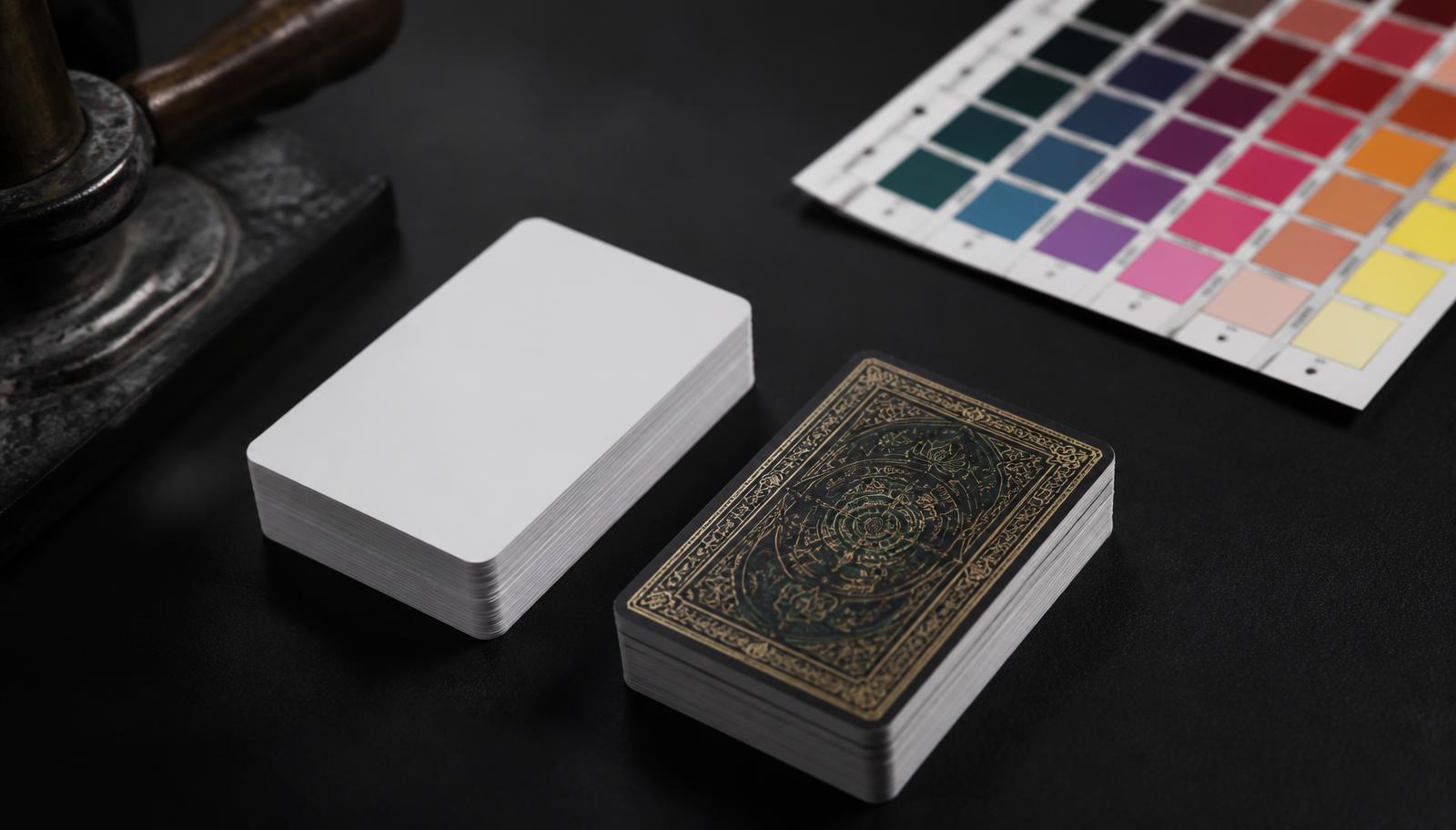
- CMYK, not RGB. Neon RGB greens and blues shift on press; convert and review early.
- 0.125 in bleed on every edge. Extend background art past the trim; do not add a white margin.
- Text 0.125 in inside the trim. Card numbers and stat lines crowded against the edge get clipped inside tolerance.
- Rich black for large dark areas (roughly 60/40/40/100) instead of 100% K, which looks washed on paper stock.
- Vector logos and type wherever possible, so foil and spot UV masks stay crisp.
- Flatten transparency and embed fonts in the exported PDF.
Start from our free card and tuck box templates and the geometry above is already set for you.
What packaging do collectible sets use?
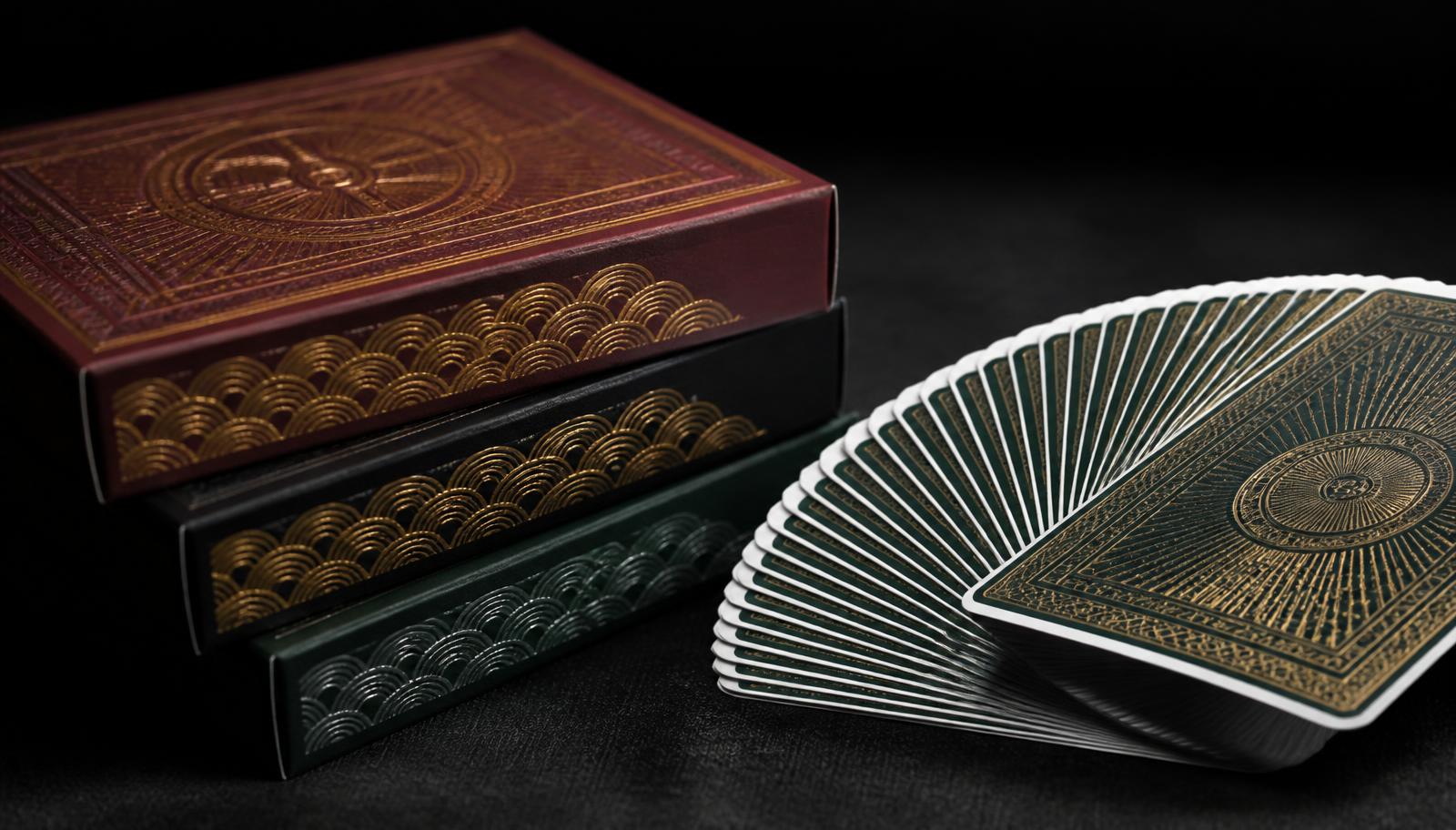
- Standard tuck box. Full-color outside, included in base pricing. Right for most sets.
- Rigid two-piece box. Adds real shelf presence for premium and limited editions.
- Shrink-wrapped brick. Cost-efficient for large giveaway or convention volume.
- Blister or booster-style packs. For sets sold as randomized packs rather than complete runs.
See tuck boxes for the packaging options that pair with each stock, and the tuck box template walkthrough for laying out the dieline.
Who orders custom trading cards?
- Youth and school sports programs printing player rosters as keepsake sets each season.
- Independent game studios running a TCG or expansion — see the TCG printing guide.
- Artists and illustrators selling limited series and convention exclusives.
- Board game publishers producing character, event, and resource cards — board game publishing.
- Brands and agencies turning a product line or team roster into a collectible handout.
- Crowdfunding creators fulfilling campaign tiers; the Kickstarter creator guide covers timing.
How long does a trading card run take?
Standard production is 2–3 weeks from approved proof, plus shipping. Foil, holographic, spot UV, or a rigid box each add 3–5 business days. Rush options can compress standard paper jobs to 7–10 business days. The clock starts at proof approval, not at order placement — the turnaround guide breaks down each step.
How to start your set
Pick trim (2.5 x 3.5 in), stock (310gsm black-core unless you need texture or plastic), finish, packaging, and quantity, then run a live quote. Send print-ready files, approve the digital proof, and your set goes on press in our Orlando facility. Not sure which spec fits your budget? Send us the project and we will quote it within one business day.
FAQs
What size are custom trading cards?
The trading card standard is 2.5 x 3.5 in — the same trim as a poker playing card. Design at 2.75 x 3.75 in to include 0.125 in bleed on all four sides, and keep text and logos 0.125 in inside the trim line.
How much do custom trading cards cost to print?
On black-core stock, expect roughly $0.36 per card at 15 decks of 52 and about $0.05 per card at 5,000+. Cards are priced by the printed set, so per-card cost falls sharply as quantity rises. Foil, holographic stock, and rigid packaging are priced as add-ons.
What card stock is used for trading cards?
310gsm black-core paper is the industry default: opaque, snappy, and colorfast. Premium linen adds grip and texture for playable TCGs, and 100% plastic is the pick when cards must survive moisture or heavy handling.
Can you print holographic or foil trading cards?
Yes. Holographic board, cold-foil, foil stamping, and spot UV are all available, and each adds roughly 3–5 business days on top of the standard 2–3 week production window.
What is the minimum order for custom trading cards?
Our minimum is 15 sets per unique design. Prototype runs at that quantity are common before a full production or campaign run scales to 500 or 1,000+.
Do you print custom sports and photo cards?
Yes. Youth sports teams, athletic programs, and photographers routinely run rosters as full-color card sets. Supply 300 DPI CMYK images and every player can have a unique face card in the same run.
Related guides
Frequently asked questions
What size are custom trading cards?
The trading card standard is 2.5 x 3.5 in — the same trim as a poker playing card. Design at 2.75 x 3.75 in to include 0.125 in bleed on all four sides, and keep text and logos 0.125 in inside the trim line.
How much do custom trading cards cost to print?
On black-core stock, expect roughly $0.36 per card at 15 decks of 52 and about $0.05 per card at 5,000+. Cards are priced by the printed set, so per-card cost falls sharply as quantity rises. Foil, holographic stock, and rigid packaging are priced as add-ons.
What card stock is used for trading cards?
310gsm black-core paper is the industry default: opaque, snappy, and colorfast. Premium linen adds grip and texture for playable TCGs, and 100% plastic is the pick when cards must survive moisture or heavy handling.
Can you print holographic or foil trading cards?
Yes. Holographic board, cold-foil, foil stamping, and spot UV are all available, and each adds roughly 3–5 business days on top of the standard 2–3 week production window.
What is the minimum order for custom trading cards?
Our minimum is 15 sets per unique design. Prototype runs at that quantity are common before a full production or campaign run scales to 500 or 1,000+.
Do you print custom sports and photo cards?
Yes. Youth sports teams, athletic programs, and photographers routinely run rosters as full-color card sets. Supply 300 DPI CMYK images and every player can have a unique face card in the same run.