
Print Playing Cards — Short Runs to Full Production
This page is about the manufacturing side: how a card job actually moves through a plant, what prepress needs from your files, and how run size changes the economics. If you are a game designer, publisher, crowdfunding creator, or agency buying print rather than shopping for a gift, start here.
- Minimum
- 15 decks
- Turnaround
- 2–4 weeks
- Printed in
- Orlando, FL
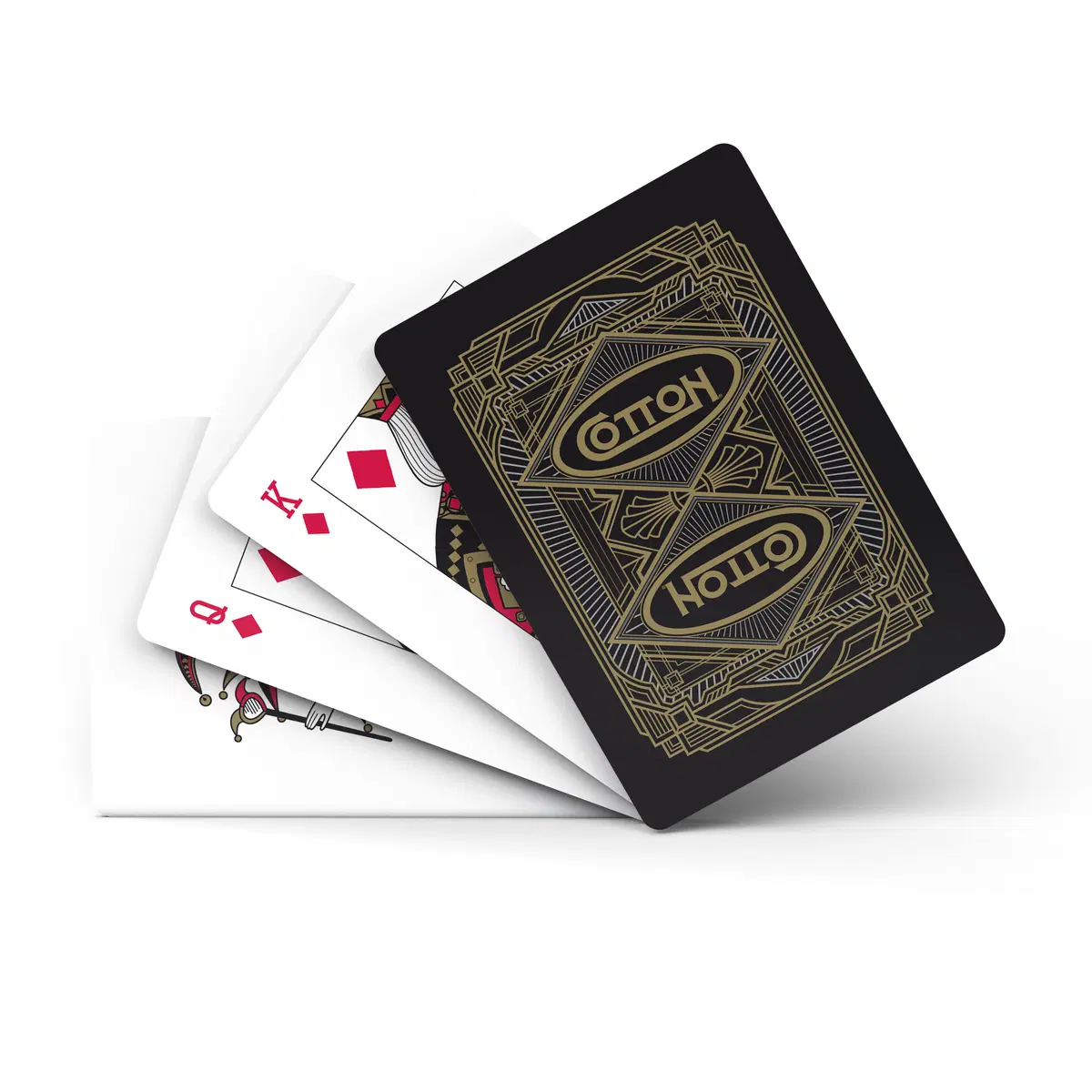
How do you print custom playing cards professionally?
Professional card printing starts with a print-ready file review, followed by a digital proof, press production, coating or finishing, die cutting, collation, packaging, and shipping. Mr. Playing Card performs this workflow in Orlando and can print short runs or larger production quantities.
What files are needed to print playing cards?
Send a print-ready PDF when possible, or an accepted AI or PSD file, at 300 DPI in CMYK. Include 0.125 inch bleed on every side and keep critical text and logos at least 0.125 inch inside the trim line. A human file review checks the setup before production.
How long does professional playing card printing take?
Standard production takes 7-10 business days from proof approval for orders up to 5,000 decks, followed by approximately 1–5 business days of US ground shipping. File review generally takes 24–48 hours before the digital proof is sent for sign-off.
What is the minimum quantity for professional card printing?
Mr. Playing Card accepts professional custom card printing orders from 15 decks. That makes the process practical for prototypes and small events while keeping a path open to 1,000-deck campaigns, retail runs, and larger fulfillment orders.
- One press, every quantity
A 15-deck playtest and a 50,000-deck retail run share stock, ink, and line.
- Card counts, not just decks
54-card decks, 108-card party games, 300-card expansions — all standard work.
- Prepress is a person
Files are reviewed by an operator, not a script, before anything is scheduled.
- Scheduled release shipping
Split large runs across drop dates or ship to a fulfillment partner.
Everything that shapes your deck — stock, size, finish, packaging, and the file you send us.
How a card job moves through the plant
Your files enter prepress, where an operator checks trim, bleed, safe zone, resolution, color space, and total ink coverage against the dieline for your size. Approved files are imposed onto press sheets — many cards per sheet, arranged to keep color consistent across the sheet rather than drifting from one edge to the other.
Printed sheets are coated, laminated around the black core, then rotary die-cut, collated into decks, boxed, and wrapped. Nothing in that sequence changes because you ordered 15 decks instead of 15,000; only the number of sheets does. That is the whole reason a prototype from us predicts the production run that follows it.
Why short-run card printing usually disappoints — and why ours does not
Most printers route short runs onto digital equipment with different stock, different ink, and a different coating than their production line. The prototype arrives looking close enough, then the production order comes back visibly different in color and feel, after the campaign art is already locked.
We keep short runs on the production line. It is less convenient for us and considerably more useful to you, especially if you are showing a playtest deck to backers before committing to fulfillment volume. The Kickstarter creator guide covers how to sequence playtest, campaign, and fulfillment runs around that.
Printing card games, not just standard decks
Card count per deck is open. Deck-builders, trick-takers, party games, TCG-style sets, educational and flashcard decks, and mixed-component games all run the same way — we simply cut and collate to your specified count. Multiple card backs within one product are fine; so are multiple trim sizes in one shipment.
What needs early attention is packaging depth. A 300-card product will not close in a standard tuck box, so decide between a deeper tuck, a rigid two-piece box, or splitting the product into multiple wrapped decks before you finalize the box artwork.
What prepress needs, precisely
Print-ready PDF is the preferred handoff; AI and 300 DPI PNG are accepted. Build in CMYK, keep 1/8 inch bleed on all four sides, keep critical artwork 1/8 inch inside the trim, and expect roughly ±1/32 inch cutting tolerance — which is why hairline borders on card backs look uneven across a full deck and full-bleed patterns do not.
Rich blacks should be built as a CMYK mix rather than 100% K alone, and any file coming out of an RGB workflow should be converted and reviewed before it is sent. Dielines for every size we cut are free on the templates page.
Getting a printing price for a run
Print quoting normally means an email thread and a two-day wait. The quote tool replaces that: enter quantity, stock, size, and packaging and it returns per-deck and total pricing immediately, with a written quote you can download and attach to a purchase order or a campaign budget.
For multi-SKU projects, quote each SKU separately and note in the submission that they run together — combined scheduling usually improves the number. Standing rate tables are published on the pricing page.
Prepress and production requirements
The technical baseline every job is checked against before it is scheduled.
| Requirement | Specification |
|---|---|
| Preferred file format | Print-ready PDF (PDF/X preferred); AI and 300 DPI PNG accepted |
| Color space | CMYK — RGB files are converted and reviewed before press |
| Resolution | 300 DPI minimum at final trim size |
| Bleed | 1/8 in on all four sides |
| Safe zone | Keep critical artwork 1/8 in inside the trim line |
| Cutting tolerance | Approximately ±1/32 in — avoid hairline borders |
| Rich black | Build as a CMYK mix rather than 100% K |
| Card count | Any count; specify per-SKU collation in the quote |
| Proofing | Digital proof of every printed surface, approval required before press |
| Scheduling | 7-10 business days from proof approval; rush available on most jobs |
Run size and what changes with it
Nothing about quality changes with volume. Economics, packaging strategy, and logistics do.
| Run size | Typical project | What changes at this tier |
|---|---|---|
| 15–50 decks | Playtest, prototype, internal review, personal run | Lowest cost of entry; ship direct, no freight planning needed |
| 100–500 decks | Trade show, league or club deck, small retail test | Best balance of per-deck price against inventory risk |
| 1,000–5,000 decks | Crowdfunding fulfillment, retail launch | Real per-deck savings; lock packaging early, plan pallet logistics |
| 5,000–50,000+ decks | National promotion, ongoing retail SKU | Volume pricing, scheduled release shipping, reserved press time |
Prototype at the tier you can afford, not the tier you can print cheaply elsewhere — a matching prototype is worth more than a fast one.
The printing workflow, start to finish
Where you are involved, and where we take over.
Specify the product
Trim size, card count per SKU, stock, packaging format, and quantity. Deeper card counts drive the packaging decision, so settle count first.
Build to the dieline
Download the exact template from the templates page and export print-ready PDFs in CMYK at 300 DPI with 1/8 in bleed.
Quote and budget
Price the run in the quote tool for per-deck and total figures plus a downloadable written quote for internal approval.
Prepress review
An operator checks trim, bleed, safe zone, resolution, color, and ink coverage at no charge, and corrects minor issues rather than rejecting the job.
Proof, press, and delivery
Approve the digital proof, the run is scheduled and printed in Orlando, then ships to you, your warehouse, or your fulfillment partner.
See your price
Pricing depends on your quantity, stock, size, and packaging. The quote tool prices your exact configuration and gives you a written quote to download — no sales call required.
Build My QuoteFrequently asked questions
- What is the smallest playing card print run you accept?
- 15 decks — printed on the production press with production stock, not on separate digital equipment.
- Will my prototype match the production run?
- Yes, because both use the same press, stock, coating, and die. That is the main reason we keep short runs off digital equipment.
- Can you print card games with unusual card counts?
- Yes. Any count, multiple backs, and multiple trim sizes within one product are all standard. Tell us the collation in your quote notes.
- What file format should I supply for card printing?
- Print-ready PDF in CMYK at 300 DPI, built on our dieline with 1/8 inch bleed on all four sides. AI and high-resolution PNG are also accepted.
- Can you ship a large run in stages?
- Yes. Scheduled release shipping and drop-shipping to a fulfillment partner are both available — note the plan when you request your quote.