
Custom Playing Cards, Printed in Orlando, Florida
Mr. Playing Card has been pressing playing cards in the United States since 1900. This is the starting point if you know you want a custom deck but have not yet decided what kind — a branded giveaway, a wedding favor, a card game, or a deck you simply want to own. Below is how the decisions fit together, and what each one changes.
- Minimum
- 15 decks
- Turnaround
- 2–4 weeks
- Printed in
- Orlando, FL
What are custom playing cards used for?
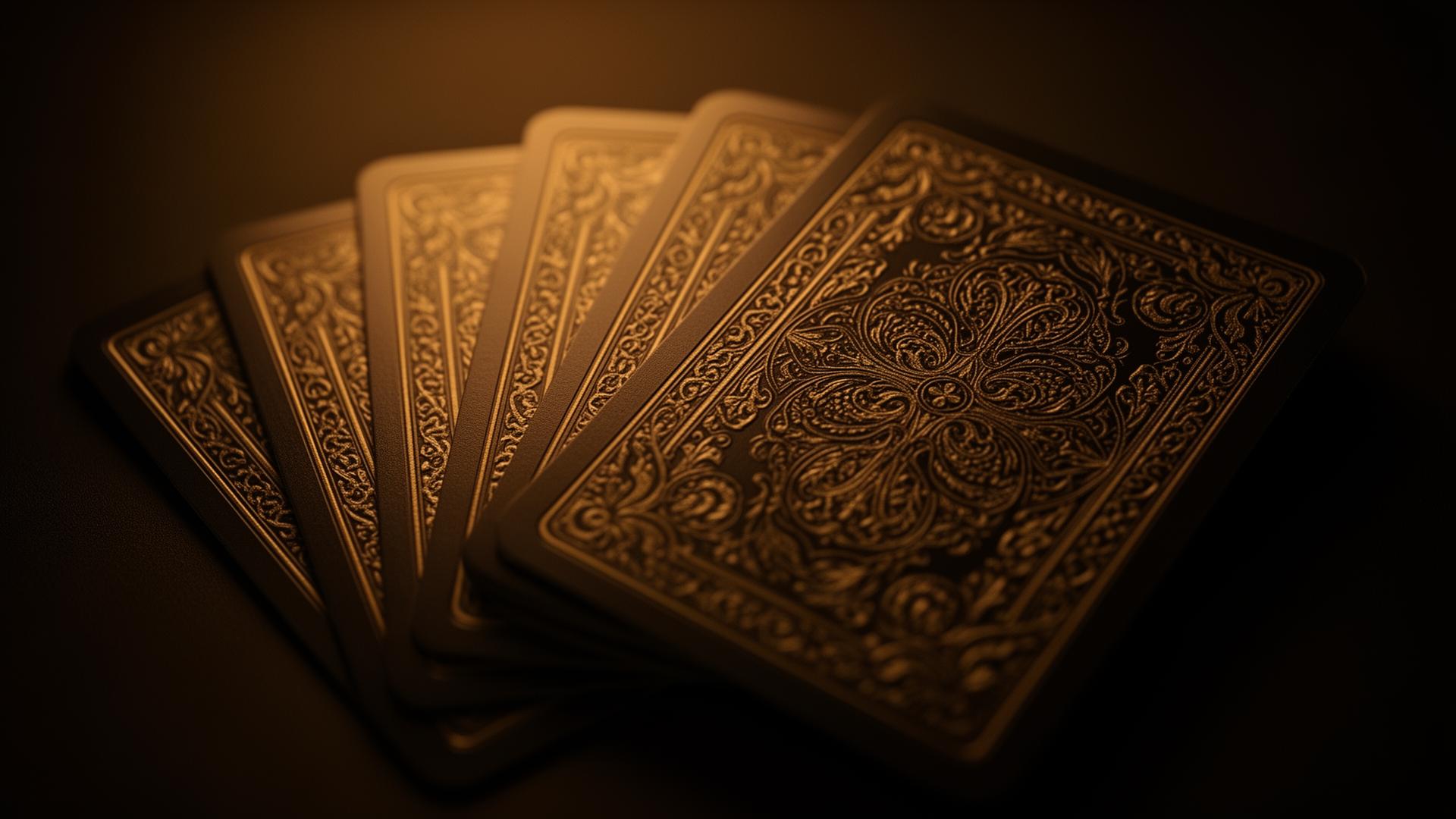
Custom playing cards are printed for branded giveaways, weddings, gifts, card games, prototypes, hospitality venues, and retail products. Mr. Playing Card can print standard poker or bridge decks, custom card counts, personalized faces, branded backs, and matching packaging from a 15-deck minimum.
Where are custom playing cards printed?
Mr. Playing Card prints, cuts, finishes, and packs custom decks in Orlando, Florida. US-based production avoids an overseas freight leg for domestic orders and provides a local file-review and proofing process before the job enters production.
- One deck, four decisions
Size, stock, card count, and packaging — everything else follows from those.
- 126 years of pressing
Same Orlando plant, same casino-grade line, whether you order 15 decks or 50,000.
- Nothing ships unseen
A prepress operator reviews your file free, then you approve a digital proof.
- No setup fees
No plate charges, no per-file charges, no minimum spend beyond 15 decks.
Everything that shapes your deck — stock, size, finish, packaging, and the file you send us.
Who orders a custom deck, and what they order
Roughly four groups keep our press busy. Companies order branded decks for trade shows, client gifts, and sales kits — usually a custom back and box with standard faces, because the deck still has to be playable on a hotel bar. Couples and families order photo decks for weddings, reunions, and milestone gifts, where all 52 faces carry a different image.
Game designers and creators order decks that are not decks at all: 108-card party games, 300-card expansions, flashcard sets, affirmation decks. And venues — card rooms, resorts, cruise lines, bars — order house decks built to survive being handled thousands of times. The press is the same in all four cases; what differs is stock, card count, and finishing.
Black core is the line between a real deck and a printed novelty
A playing card is a laminate: two printed sheets bonded around a middle layer. When that middle layer is black, light cannot carry a face image through to the back, which is why a black-core deck stays honest under a lamp and a white-core deck does not. Every paper stock we run is black core, and our plastic stock is opaque by construction.
The second half of the equation is the coating. A slip finish lets cards release from one another during a riffle instead of dragging, which is the difference a player notices in the first thirty seconds. We coat every deck as standard rather than selling it as an upgrade.
What is actually customizable
Card backs, tuck box, jokers, and the ace of spades are the common four. Beyond that: every face, the court card illustrations, the pip shapes, the index typography, the card count, the trim size, and the box construction. Finishing adds metallic foil stamping, spot UV, soft-touch lamination, embossing, and gilded edges in gold, silver, or a matched custom color.
The only real constraint is playability. If people will use the deck for a game, keep indices in the standard corners at a size readable in poor light. If it is a gift, an art object, or a display piece, nothing is off limits. The card stock and materials page shows what each stock does to the finished feel.
What it costs, and why there is no price list here
Four variables move the number — quantity, stock, trim size, and packaging — and they interact. Publishing a single flat rate would be wrong for almost everyone reading this page, so we built the quote tool instead: enter your configuration and it returns real per-deck and total pricing in about thirty seconds, plus a written quote you can download and forward internally.
There is no obligation attached, and no sales call is required to get the number. Full published rate tables also live on the pricing page if you would rather read them than configure a quote.
Sending us files, with or without a designer
Print-ready PDF, AI, or 300 DPI PNG in CMYK, built against the dieline for your trim size with 1/8 inch bleed on all four edges. Every dieline we run — cards and tuck boxes — is free on the templates page.
If there is no designer on the project, the online designer assembles a printable deck in the browser from images you upload and handles bleed and placement for you. Either route ends at the same place: a human in prepress checks the file and corrects small problems at no charge instead of bouncing your order back.
The four decisions, and what each one changes
Rather than a spec dump, this is the decision tree. Work down the left column and you have a complete configuration.
| Decision | Options | What it changes |
|---|---|---|
| Trim size | Poker · bridge · jumbo · mini · custom die | Hand feel, how many cards fan comfortably, dieline you design against |
| Card stock | 300 GSM smooth · 310 GSM black-core linen · 100% plastic | Snap, texture, lifespan, and per-deck cost |
| Card count | 54 standard, any count on request | Deck thickness, box depth, price per unit |
| Packaging | Printed tuck · rigid two-piece · sleeve · shrink or cello wrap | Shelf presence, gift readiness, unit cost |
| Finishing | Foil · spot UV · soft-touch · emboss · gilded edges | Perceived value and lead time |
Every combination above is priced live in the quote tool — nothing here requires a conversation first.
Matching the build to the job
The configurations we quote most often, by what the deck is for.
| Project | Typical build | Why |
|---|---|---|
| Trade show giveaway | Poker · 310 GSM linen · printed tuck | Feels premium in hand, survives a show floor, lowest risk |
| Wedding or family gift | Poker · 300 GSM smooth · foil tuck | Photo reproduction is flattest and cleanest on smooth stock |
| Card game or expansion | Custom count · 310 GSM linen · rigid box | Higher counts need box depth; linen handles repeat shuffling |
| Venue or house deck | Poker · 100% plastic · shrink wrap | Washable and effectively tear-proof under constant play |
| Prototype before a launch | 15–50 decks · production stock | Same press and stock, so the prototype predicts the real run |
From idea to decks on your desk
Five steps. Only the second one might need a designer.
Settle the four decisions
Size, stock, card count, packaging. If nothing is obvious yet, poker size on 310 GSM black-core linen with a printed tuck is the build we quote most and the hardest one to regret.
Get artwork onto the dieline
Download the matching template from the templates page, or skip design entirely and assemble the deck in the online designer.
Price the exact configuration
The quote tool returns per-deck and total pricing for your spec plus a written quote you can download and share.
Free file review, then a proof
Prepress checks bleed, resolution, and color space at no charge and fixes small issues, then sends a digital proof of every face, back, and box for approval.
Press, pack, ship
The job runs in Orlando in 7-10 business days from proof approval and ships direct to you or to your fulfillment address.
See your price
Pricing depends on your quantity, stock, size, and packaging. The quote tool prices your exact configuration and gives you a written quote to download — no sales call required.
Build My QuoteFrequently asked questions
- What is the minimum order for custom playing cards?
- 15 decks. That is a true production minimum rather than a sample tier — a 15-deck run uses the same press, stock, and finishing as a 50,000-deck order.
- Are your custom playing cards printed in the USA?
- Yes. Printing, cutting, finishing, and packing all happen at our Orlando, Florida plant. Nothing is outsourced overseas.
- How much do custom playing cards cost?
- It depends on quantity, stock, trim size, and packaging together. The quote tool prices your exact configuration instantly, and published rate tables are on the pricing page.
- Can I see and feel the stocks before I commit?
- Yes. We can ship samples of previous decks on request so you can feel the stock and finish in hand, and every order gets a digital proof before it goes to press.
- Do you charge setup, plate, or artwork fees?
- No. There are no setup charges, no plate fees, and no per-file charges — including on full 52-image photo decks.