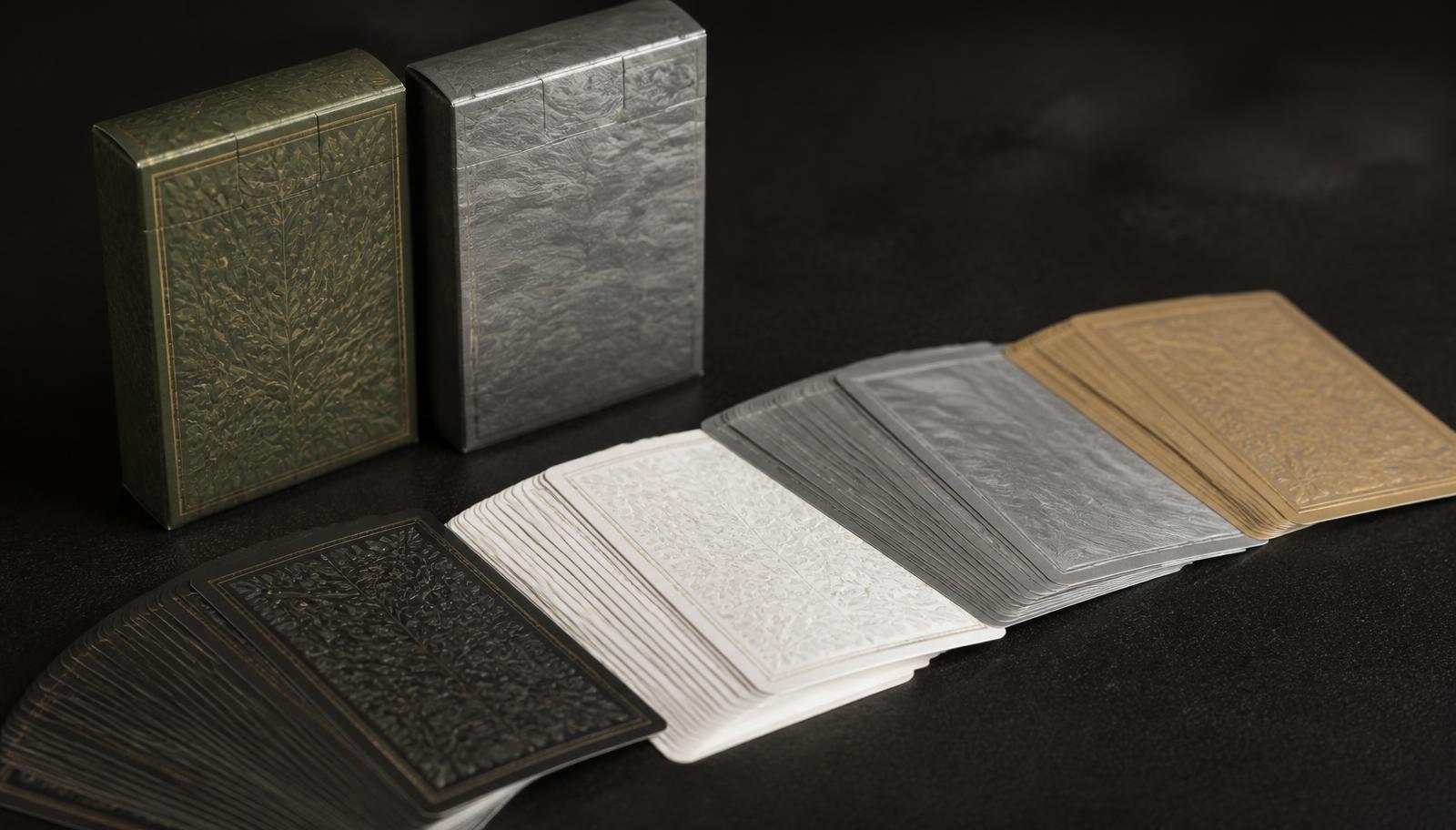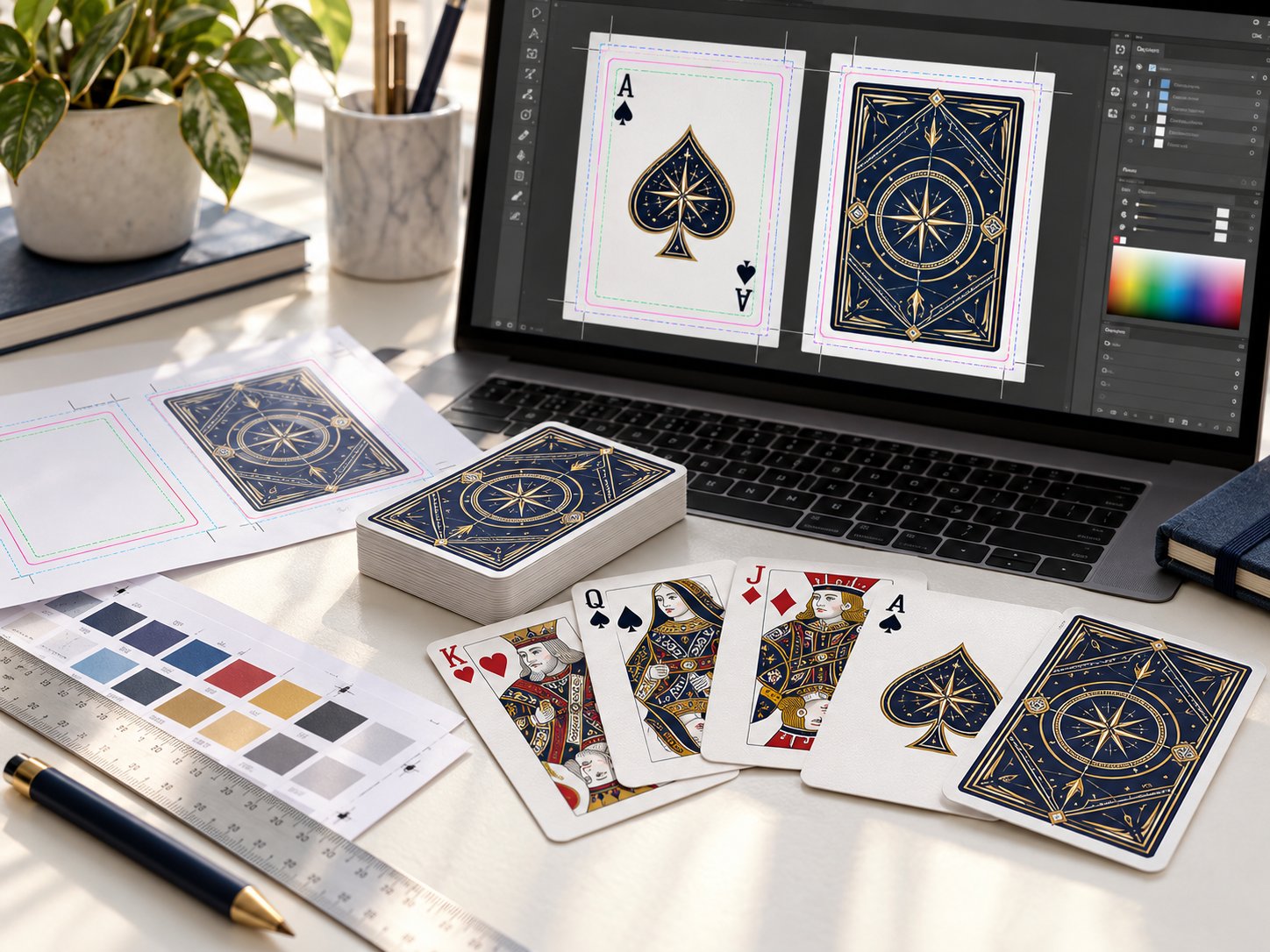
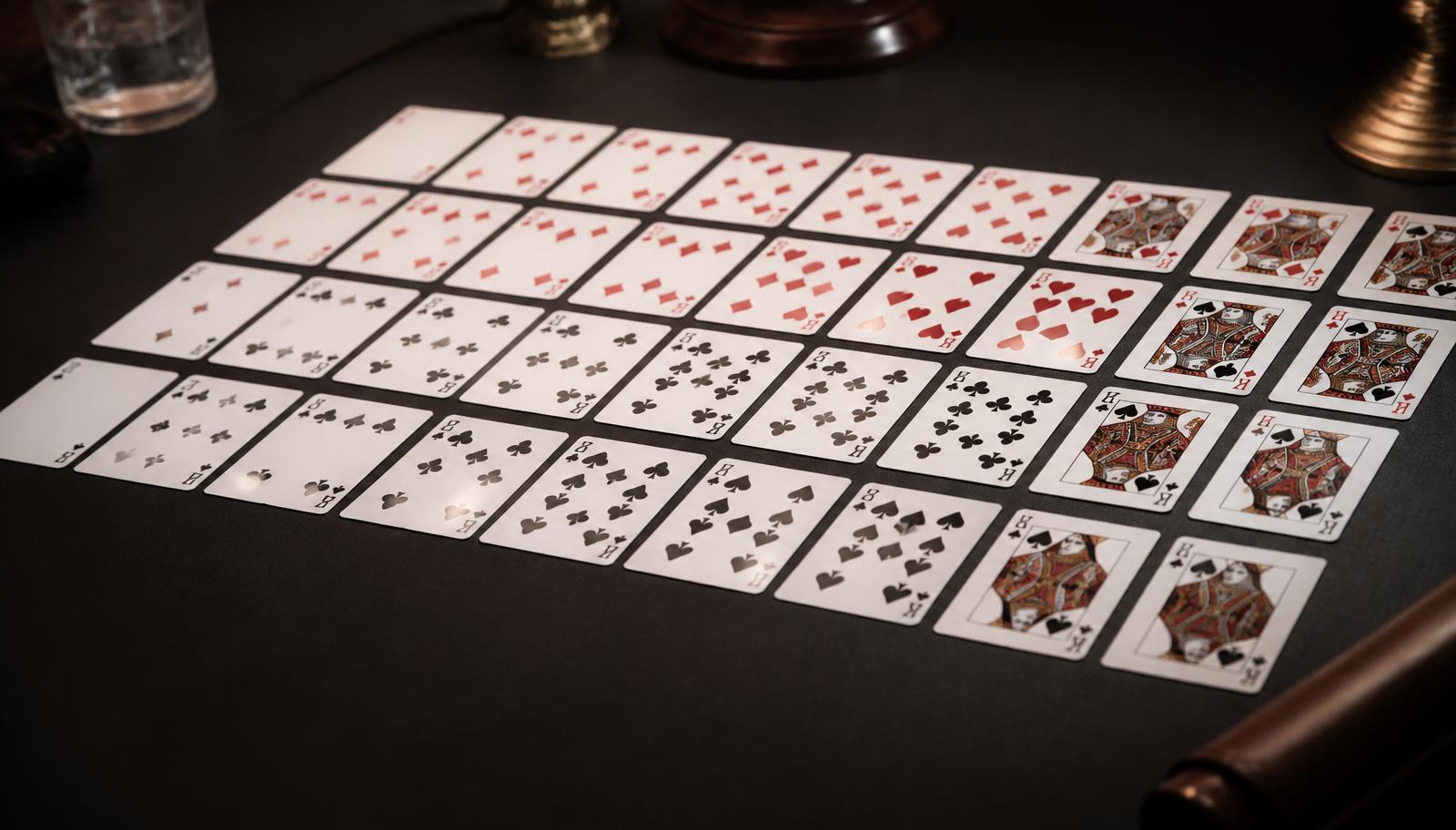
A standard deck has 52 cards. Retail packs usually add two jokers for 54. Everything else about a deck of cards, including the suit math, the face card count, and the many regional variants, follows from that base. This guide gives the complete breakdown, then covers what changes when you print a custom deck.
How many cards are in a deck?
52. Four suits, 13 cards per suit. That structure has been stable in the French-suited deck used across the United States and most of Europe for centuries, and it is why 52 is the number nearly every card game assumes.
What sits in the box you buy is often 54, because manufacturers include two jokers. Many packs also contain an advertisement card or a blank card, so a physically full pack can hold 55 pieces of card stock while the playable deck is still 52.
The complete count table
| Group | Count | Notes |
|---|---|---|
| Total playing cards | 52 | Standard French-suited deck |
| Suits | 4 | Spades, hearts, diamonds, clubs |
| Cards per suit | 13 | Ace through 10, jack, queen, king |
| Red cards | 26 | Hearts + diamonds |
| Black cards | 26 | Spades + clubs |
| Face cards | 12 | Jack, queen, king in each suit |
| Aces | 4 | One per suit |
| Number cards | 36 | 2 through 10 in each suit |
| Jokers | 2 | Included in most retail packs |
| Pack total with jokers | 54 | Common retail configuration |
How many face cards are in a deck?
12. Each suit contributes a jack, a queen, and a king. Because these three carry human figures, they are also called court cards, and in print production they are the most detailed art in the deck.
Aces are not face cards. They carry a single pip, not a figure. Players often lump aces in with the high cards because of how games score them, and under that looser definition you get 16 cards. For any exam question, quiz, or probability problem, use 12.
How many cards of each suit?
13 per suit. The sequence is ace, 2, 3, 4, 5, 6, 7, 8, 9, 10, jack, queen, king. Multiply by four suits and you land on 52.
- Spades: 13, black
- Hearts: 13, red
- Diamonds: 13, red
- Clubs: 13, black
That gives a clean 26/26 color split, which is why so many probability lessons start with "draw a red card." The odds of drawing a red card from a full deck are 26/52, or exactly one half.
Why are there jokers?
The joker entered the deck in the United States in the 1860s as a trump card for euchre, and manufacturers never stopped printing it. Today it functions as a wild card in games like canasta and countless house rules, and as a spare when a card is damaged. Because it has no fixed role, it is also the card most custom deck creators use for a brand mark, a signature, or an easter egg.
Common deck variants and their counts
Card count is a game design decision, not a law of nature. The most common variants:
| Deck | Cards | Composition |
|---|---|---|
| Standard | 52 | 4 suits x 13 |
| Standard + jokers | 54 | 52 plus 2 jokers |
| Pinochle | 48 | Two copies of 9-A in all suits |
| Euchre | 24 | 9 through ace, all suits |
| Piquet / 32-card | 32 | 7 through ace, all suits |
| Spanish 40-card | 40 | 4 suits x 10, no 8s, 9s, or 10s |
| Affirmation | varies | Often 44, 52, or 78 cards |
| Custom game deck | varies | Set by the designer |
Most of these are subtractions from the same 52-card base. Pinochle is the exception, doubling a subset instead of trimming it.
Does card count change the card size?
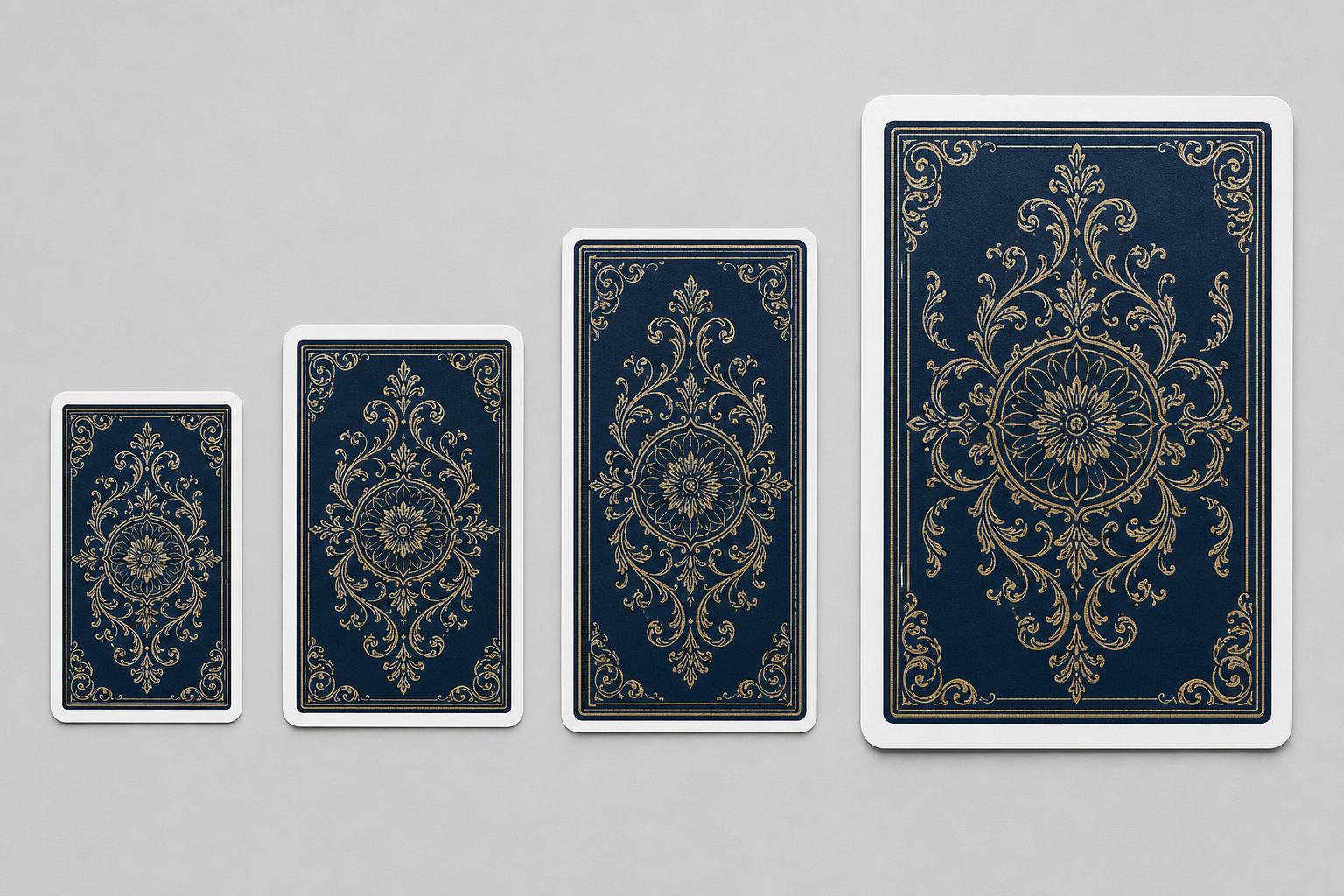
No. A poker card is 2.5 x 3.5 in and a bridge card is 2.25 x 3.5 in, regardless of how many cards are in the deck. Both share the same height; bridge is simply narrower, which is why it is favored in games that require holding many cards at once. Our playing card sizes guide covers the full dimension list, including jumbo formats.
What card count does change is packaging depth. A 52-card deck on 310 GSM stock sits near 0.75 in thick, and a 200-card game deck needs a much deeper box, so the dieline is cut to the specific count. See the custom tuck box guide for how that gets specified.
Choosing a card count for a custom deck
If you are printing your own deck, count is a spec you set. A few practical guidelines:
- Standard play: stay at 52 plus two jokers so your deck works with every game people already know.
- Promotional decks: stay standard. A promotional deck that cannot play poker loses most of its use, and use is the whole point of a giveaway.
- Original card games: count follows your rules, not tradition. Prototype, playtest, then lock the count before art is finalized, because count drives both price and box depth.
- Affirmation decks: 44, 52, and 78 are all common in the affirmation category; print the count on the box so buyers know what they have.
Count is also a price lever. More cards means more stock and more press time per unit, so a 200-card game deck costs meaningfully more per unit than a 52-card deck at the same run size. Check the pricing page for run-size breaks, or run your exact count through the quote tool.
Probability quick reference
Because "how many cards in a deck" is usually asked to solve something, the shortcuts:
- Any specific card: 1/52
- Any given rank, for example a king: 4/52 = 1/13
- Any given suit: 13/52 = 1/4
- A red card: 26/52 = 1/2
- A face card: 12/52 = 3/13
- A face card or an ace: 16/52 = 4/13