Blank Playing Cards: Sizes, Stocks, and When to Print Custom Instead (2026 Guide)
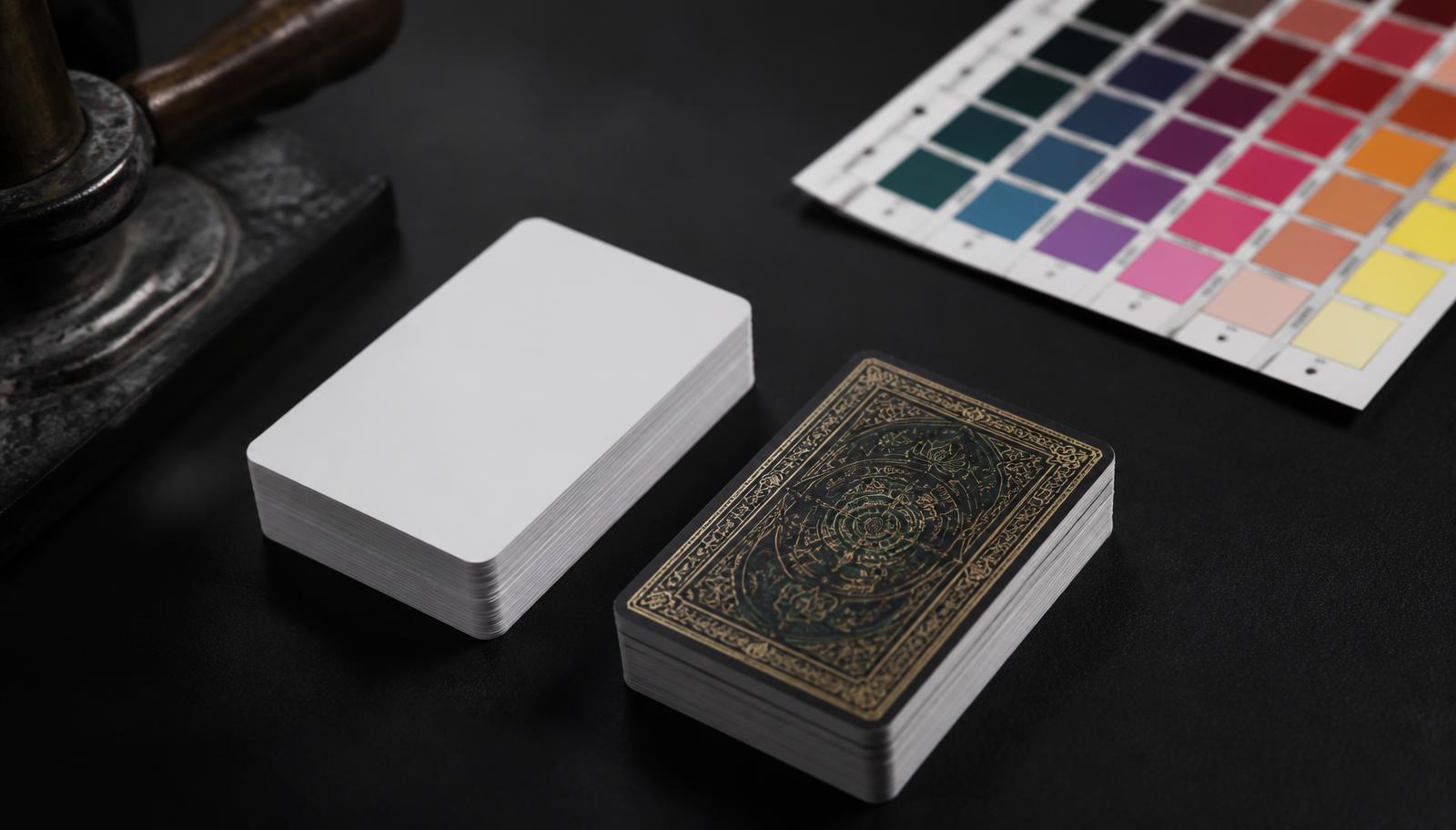
Blank playing cards are unprinted card blanks sold in packs for handwriting, stamping, or inkjet printing at home. They cost pennies per card and are excellent for prototyping a game mechanic or running a write-your-own party deck. They are not a substitute for press-printed cards: blank stock is thinner, uncoated, and cut to looser tolerances, so it curls and frays fast. This guide covers what blank decks actually are, the sizes and stocks you can buy, how to print on them, and the exact point where custom printing becomes both cheaper and better.
What are blank playing cards?
A blank playing card is a die-cut, rounded-corner card with no printing on either face. Packs usually run 52, 100, or 180 cards in poker size. The stock is normally 240–300gsm uncoated cardstock — a single layer of paper with no opaque black core between plies. That single detail drives most of the differences below: without a black core, a bright light behind the card reveals the design on the other side.
Blank card sizes you can actually buy
Most blanks come in one size. Custom printing is the only route to the rest.
| Size | Dimensions | Sold blank? | Common use |
|---|---|---|---|
| Poker | 2.5 x 3.5 in | Widely | Standard decks, party games |
| Bridge | 2.25 x 3.5 in | Rarely | Bridge, smaller hands |
| Jumbo | 3.5 x 5.75 in | Almost never | Affirmation, oversized decks |
| Mini | 1.75 x 2.5 in | Occasionally | Travel games, inserts |
| Custom dieline | Any | No | Branded shapes, custom trims |
If your project needs anything beyond poker or bridge, see the complete playing card sizes guide before you commit artwork to a size.
How do blank cards compare to printed card stock?
Blank craft stock and press stock are not the same material. Here is the honest comparison.
| Attribute | Typical blank pack | Press-printed custom deck |
|---|---|---|
| Weight | 240–300gsm | 300–310gsm, or 100% plastic |
| Core | None (single ply) | Opaque black core |
| Coating | Uncoated | Smooth, matte, or linen air-cushion |
| Cut tolerance | ±0.03–0.05 in | ±0.02 in |
| Shuffle life | Dozens of plays | Thousands of plays |
| Face printing | Your printer / pen | Full-color CMYK both sides |
The core matters more than most buyers expect. A deck without one is semi-translucent under table lighting, which makes it unusable for poker, magic, or anything competitive. Read the card stock comparison for how black-core paper stacks up against 100% PVC.
How to print on blank playing cards at home
If you are staying DIY, these steps produce the cleanest result an inkjet can:
- Buy uncoated blanks. Coated or plastic blanks will not accept inkjet ink; it beads and smears.
- Build a template at 300 DPI. Set the card at 2.5 x 3.5 in with 0.125 in bleed and keep text 0.125 in inside the trim.
- Test on plain paper first. Print one page, hold it against a blank card, and check alignment before you feed real stock.
- Feed cards one at a time. Stacked blanks jam and double-feed on almost every consumer tray.
- Let ink cure 30+ minutes. Uncoated stock stays tacky and will offset onto the next card.
- Expect misfeeds. Budget 10–15% waste; that waste is where the DIY cost advantage quietly disappears.
Our free downloadable templates carry the same bleed and safe-zone geometry, so a prototype you lay out today can go straight to press later without re-drawing anything.
When is a custom printed deck cheaper than blanks?
Run the math on total cost, not sticker price. A 100-card blank pack around $10–$15 plus ink, plus your time, plus reprints lands most people near $0.30–$0.50 per usable card once waste is included. That is roughly $15–$25 per 52-card deck — the same neighborhood as our 15-deck minimum, and without the black core, the coating, or the tuck box.
| Quantity | Custom per deck (black-core paper) |
|---|---|
| 15 | $18.99 |
| 50 | $8.99–$10.49 |
| 250 | $5.09–$5.59 |
| 1,000 | $2.59–$2.99 |
| 5,000+ | $1.67–$1.94 |
At 50 decks, custom printing is already less than half the effective cost of DIY blanks. Full tiers and add-ons live on the pricing page, and the cost breakdown guide explains what each option adds.
What blank cards are genuinely good for
There are real uses. Keep blanks for these:
- Mechanic testing. Handwrite 60 cards, play three rounds, and throw out what does not work. No print run survives that iteration speed.
- Write-your-own party decks. Fill-in-the-blank games only work if the cards are blank.
- Classroom and training exercises. Disposable by design.
- Table-side promotions. One-off raffle or drawing cards where nobody keeps them.
Once a design stops changing, it should leave blank stock. Prototyping on blanks and printing the finished game on game card stock is the standard workflow for the board game publishers we run — see the board game card printing guide for that handoff.
What blank cards cannot do
- Hold a full-bleed face design. Home printers cannot print edge to edge, so you get a white border whether you wanted one or not.
- Stay opaque. No black core means marked-deck problems in any lit room.
- Survive a real shuffle. Uncoated fibers grab, and edges fray inside a week of daily play.
- Match color across a batch. Consumer heads drift; press runs are profiled to one target.
- Scale. Hand-feeding 1,000 cards is a weekend. Pressing 1,000 decks is a scheduled job.
What stock should replace blanks for a finished project?
- 310gsm black-core paper, smooth finish — the default for most decks; best price-to-quality ratio.
- Premium linen — air-cushion texture, best fan and grip for card games and magic.
- Deluxe black-core — heavier feel and maximum opacity for premium retail editions.
- 100% plastic — waterproof and near-indestructible for casino, pool-side, or outdoor use.
How do you move a blank prototype to production?
Once your handwritten deck settles, the path to a printed run is short:
- Rebuild each card in a real file at 300 DPI, CMYK, with 0.125 in bleed.
- Pick size and stock (poker + 310gsm black-core covers most projects).
- Run a quote at your target quantity to see where the price breaks land.
- Submit files, review the digital proof, approve, and go to press.
Standard production is 2–3 weeks from approved proof — the turnaround guide breaks that down step by step. If you are funding through a campaign, the Kickstarter creator guide covers timing your print run against fulfillment promises.
FAQs
Where can I buy blank playing cards?
Craft retailers, office supply chains, and online marketplaces sell blank decks in 52- to 180-card packs, typically 240–300gsm uncoated. They are fine for prototyping and party games, but the stock is thinner and less durable than press-printed 310gsm black-core cards.
Can you print on blank playing cards with a home printer?
Yes, on uncoated blank cards only. Coated or plastic-finish blanks repel inkjet ink and smear. Expect off-register edges of 0.05 in or more because home printers cannot hold the tight tolerance a die-cut deck needs.
What size are blank playing cards?
Most blanks ship in poker size, 2.5 x 3.5 in. Bridge size is 2.25 x 3.5 in. Blank packs almost never offer jumbo or fully custom dielines, which is one reason custom printing wins for anything non-standard.
Is it cheaper to buy blank cards or print custom?
Blanks are cheaper per card up front. Once you factor in ink, your labor, and reprints for misfeeds, custom printing is usually cheaper past roughly 15–25 decks and always better in finish quality.
Do blank playing cards shuffle well?
Not for long. Blank craft stock is typically uncoated single-ply, so it absorbs hand oils, curls, and frays within a few dozen plays. Black-core stock with a linen or smooth coating is the durable option.
Related guides
Frequently asked questions
Where can I buy blank playing cards?
Craft retailers, office supply chains, and online marketplaces sell blank decks in 52- to 180-card packs, typically 240–300gsm uncoated. They are fine for prototyping and party games, but the stock is thinner and less durable than press-printed 310gsm black-core cards.
Can you print on blank playing cards with a home printer?
Yes, on uncoated blank cards only. Coated or plastic-finish blanks repel inkjet ink and smear. Expect off-register edges of 0.05 in or more because home printers cannot hold the tight tolerance a die-cut deck needs.
What size are blank playing cards?
Most blanks ship in poker size, 2.5 x 3.5 in. Bridge size is 2.25 x 3.5 in. Blank packs almost never offer jumbo or fully custom dielines, which is one reason custom printing wins for anything non-standard.
Is it cheaper to buy blank cards or print custom?
Blanks are cheaper per card up front. Once you factor in ink, your labor, and reprints for misfeeds, custom printing is usually cheaper past roughly 15–25 decks and always better in finish quality.
Do blank playing cards shuffle well?
Not for long. Blank craft stock is typically uncoated single-ply, so it absorbs hand oils, curls, and frays within a few dozen plays. Black-core stock with a linen or smooth coating is the durable option.